


Digital Literacy in 2026: A Guide to Intentional Living for Kiwis

What if the technology meant to simplify your life is actually the primary source of your daily friction? In 2026, true digital literacy is not about chasing every new trend. It is about having the systems to use tools on your own terms. You might feel the weight of constant updates. Perhaps you feel a sense of dread when a government portal changes its layout. It's a common struggle. A 2024 report from the Citizens Advice Bureau highlighted that many Kiwis feel increasingly alienated by "digital by default" services.
You likely value your independence but find yourself relying on others for basic tasks. This reliance creates a quiet anxiety that shouldn't be there. Discover how modern digital literacy provides the clarity and agency you need to navigate life in New Zealand with confidence. We will look at how to simplify your digital environment and build habits that put you back in the driver's seat.
Key Takeaways
Understand why modern digital literacy is no longer about reading and writing, but about having the agency to navigate digital spaces with confidence.
Identify how tech anxiety creates invisible barriers between you and your goals, often leading to missed connections within your community in Aotearoa.
Learn how to build sustainable digital habits by focusing on your immediate needs rather than trying to master every new technology at once.
Discover a quiet, jargon-free approach to coaching that helps you reclaim your focus and live more intentionally in a digital world.
Table of Contents What is Literacy in the Digital Age? The High Cost of Digital Illiteracy How to Build Your Digital Confidence Digital Confidence Coaching for Everyday Kiwis
What is Literacy in the Digital Age?
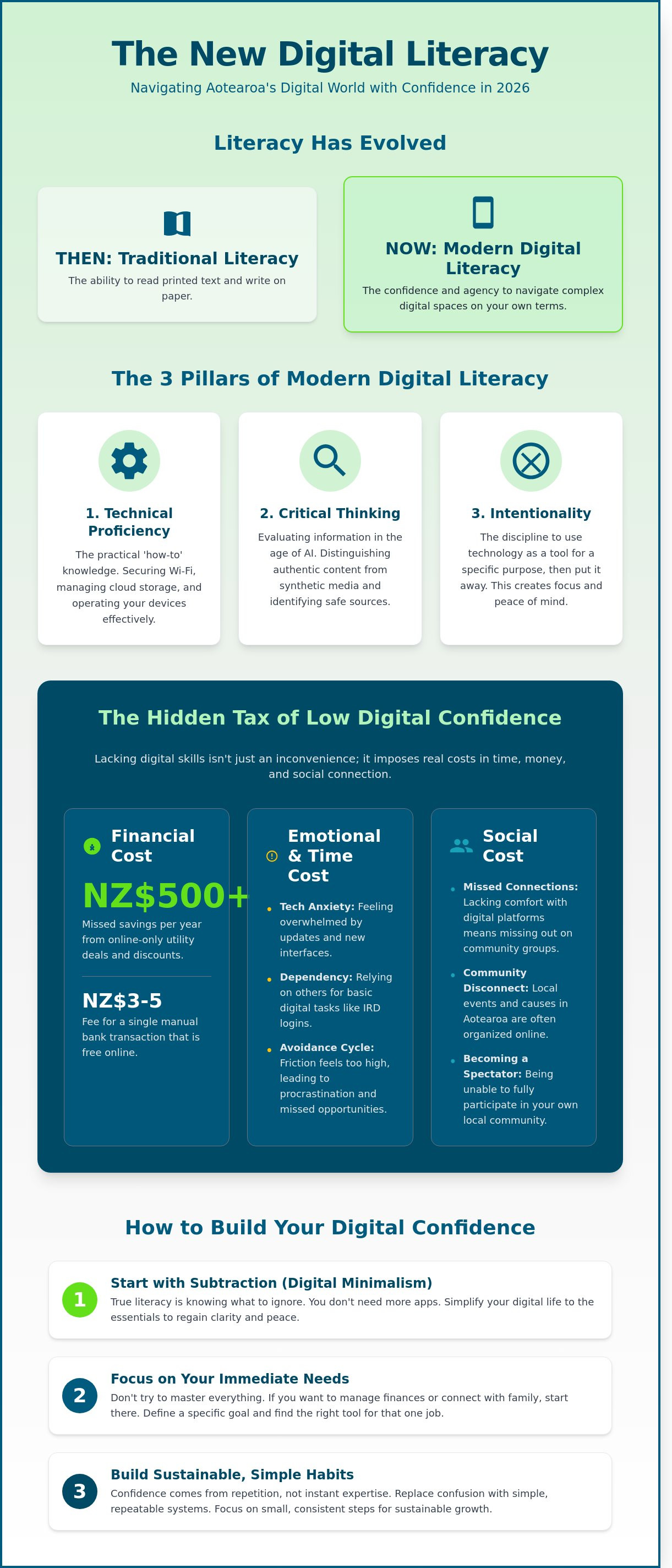
Literacy was once defined by your ability to read a printed book or write a letter. In 2026, that definition has shifted. True literacy now means having the confidence to navigate complex digital environments without feeling overwhelmed. It is about personal agency. You deserve to participate in society on your own terms, rather than being a passive consumer of technology.
When you master this skill, you regain control. You can live an intentional life. Technology becomes a tool for your growth, not a source of constant stress or distraction. It's the difference between being used by your devices and using them to build the life you want. This transition requires a move from passive consumption to active, disciplined management of your digital space.
The Shift from Traditional to Digital Skills
Basic reading is only the first step. Today, you must interpret data, manage privacy settings, and identify automated systems. The New Zealand Government’s Digital Strategy for Aotearoa, launched in 2022, views digital inclusion as a fundamental right for every Kiwi. Without these skills, you face real barriers to essential services.
Health: Accessing Te Whatu Ora records or booking appointments through patient portals.
Banking: Managing your finances as physical branches closed at a rate of 15 percent per year between 2020 and 2023.
Connection: Staying in touch with family through secure, encrypted platforms without compromising your data.
The Three Pillars of Modern Literacy
Modern literacy rests on three distinct foundations. Each pillar supports your ability to remain calm and focused in a noisy world.
Technical proficiency is the first pillar. This is the practical knowledge required to operate the devices you own. It means knowing how to update your software, secure your home Wi-Fi, and manage your cloud storage effectively. It's about the mechanics of your digital life.
Critical thinking involves evaluating the information you consume. In an era of generative AI, you must distinguish between authentic content and synthetic media. You need to know which sources are safe and which are designed to exploit your attention. This pillar protects your mind from misinformation.
Intentionality is the final pillar. It's the most important factor for your peace of mind. This means choosing the right tool for a specific purpose. You don't check your email when you mean to play with your kids. You use technology to achieve a goal, then you put it away. This discipline creates the freedom you're looking for.
The High Cost of Digital Illiteracy
Digital literacy isn't a luxury. It is a fundamental requirement for navigating life in New Zealand safely and efficiently. When you lack these skills, you pay a "hidden tax" in both time and money. This gap creates a barrier between you and the life you want to lead.
Tech anxiety often stops Kiwis from engaging with the tools that could simplify their lives. It's a heavy emotional weight. Feeling dependent on a family member to help with a basic IRD login or a bank transfer erodes your sense of agency. This dependency often leads to a cycle of avoidance. You stop trying because the friction feels too high.
The financial impact is concrete. In 2024, many New Zealand banks increased fees for manual, over-the-counter transactions. You might pay NZ$3 to NZ$5 for a simple transfer that is free online. Research suggests that households without digital confidence miss out on over NZ$500 per year in savings from online-only utility deals and insurance discounts. Missing these opportunities is a direct result of low literacy in digital spaces.
Beyond money, there is a social cost. Community groups and local events in Aotearoa move fast. If you aren't comfortable with digital platforms, you miss the chance to connect with your neighbors or contribute to local causes. You become a spectator in your own community.
Overcoming the Fear of Being Left Behind
Tech anxiety is a common experience for many everyday Kiwis. It's not a personal failure. The digital world moves quickly; it's natural to feel overwhelmed. A calm and grounded approach changes everything. You don't need to master every new gadget. You just need a system. When you replace confusion with simple habits, the fear disappears. Focus on one task at a time. Learning is about sustainable growth, not instant expertise.
Digital Minimalism: Less Tech, More Clarity
True literacy often means knowing what to ignore. You don't need more apps or more notifications. Use the subtraction method. Find peace by simplifying your digital life to the essentials. Digital tools should create freedom, not more work. By building intentional habits, you ensure your devices serve your goals. You gain clarity when you stop chasing every update and start focusing on what actually adds value to your day.
How to Build Your Digital Confidence
Digital confidence starts with subtraction. You don't need to master every app or platform. Focus only on what serves your current lifestyle. If you want to manage your finances or connect with family, start there. Sustainable growth happens when you build small, repeatable habits over time.
True digital literacy is about intentionality. It is the difference between being a passive consumer and an active participant. You move from scrolling aimlessly to using tools that provide real value. This shift requires a pace that respects your experience. You aren't "behind"; you are simply choosing a different speed that prioritizes clarity over clutter.
A Checklist for Digital Agency
Agency means having control over your digital environment. It is about self-reliance rather than dependence. Use this checklist to assess your current comfort level:
Can you safely manage your own logins and online security using a password manager?
Do you feel comfortable using government portals like My IR or essential service apps?
Are you able to use video calls to stay connected with loved ones without feeling stressed?
Why 1-on-1 Coaching Beats Online Tutorials
YouTube is a noisy place. Tutorials often move too fast and skip the context you actually need. This leaves many Kiwis feeling more confused than when they started. In 2024, data from local community education providers indicated that 21 percent of adults felt overwhelmed by the pace of online instructions. Personalized support offers a different path.
A trusted mentor provides a quiet space to learn. They tailor the experience to your specific life and your specific device. They don't give you a generic script; they help you build systems that work for you. This human connection is what creates long-term digital literacy. It replaces the dopamine hit of a quick fix with the lasting peace of actual understanding.
Confidence is a byproduct of consistent, simple actions. You don't need a complex secret. You just need a system that aligns with your values. If you are ready to move from confusion to clarity, start building your digital skills today with a focus on intentional living.
Digital Confidence Coaching for Everyday Kiwis
Most digital training feels like a corporate lecture. You don't need to be an IT expert to feel in control. Achieve With Nate provides a quiet space to build your skills without the noise. There is no jargon or hype here. We focus on the practical tools you use every day in New Zealand. This is about building digital literacy that serves your life, not the other way around.
Managing your tech shouldn't feel like a second job. By focusing on essential systems, you can create a more intentional and less stressful digital existence. This approach removes the friction from your daily routine. You gain more time for the things that actually matter in your life. It is a process of subtraction, where we remove the digital clutter that slows you down.
Meet Nate: Your Guide to Digital Freedom
Nate is a practitioner who has tested these systems in real life. He doesn't focus on corporate IT setups or complex enterprise software. Instead, he helps everyday Kiwis manage their personal technology. His approach is grounded and realistic. He knows your time is a finite resource. Success comes from simple actions and consistent habits rather than complex secrets.
Nate skips the loud hype of modern tech culture. He prioritizes freedom and peace of mind over traditional markers of status. You get a mentor who values clarity. He has spent over 1,000 hours refining these methods to ensure they work for people, not just machines. This focus on practical literacy ensures you only learn what you need to thrive in a Kiwi context.
Taking the Next Step Toward Clarity
Mastering your digital world brings long-term satisfaction. You can start with a coaching session that fits your schedule. We look at your specific needs and remove the friction from your devices. By 2026, the gap between those who control their tech and those who are controlled by it will likely widen. You can choose clarity over chaos right now.
The goal is a sustainable digital lifestyle. We remove the apps and habits that drain your energy. You leave with a clear plan and the confidence to execute it. This is about reclaiming your focus. Book a digital confidence coaching session today to begin your journey toward digital freedom.
Your Path to a More Intentional Future
By 2026, the definition of literacy has shifted from basic computer skills to the mastery of your own attention. You've explored how unintentional tech use creates hidden costs; research suggests these gaps contribute to the NZ$15 billion New Zealand loses annually in potential productivity. Real digital confidence comes from building simple systems that serve your life rather than distracting from it.
You don't need to be a tech expert to thrive. You just need a clear plan. My coaching is designed for everyday Kiwis who want to move away from hustle culture toward a quieter, more disciplined way of living.
We work through practical, 1-on-1 sessions. There's no complex jargon. We focus on digital minimalism and intentional habits that stick. It's about finding clarity in a world designed to keep you scrolling.
It's time to stop reacting to notifications and start designing a life of purpose. Start your journey to digital confidence with Nate today. You have the agency to create the freedom you're looking for.
Frequently Asked Questions
What is the best way to start learning digital skills as an adult?
The most effective way to start is by identifying one specific problem you need to solve, like managing your household budget or booking a doctor's appointment online. Focus on small, intentional wins. In 2024, 21 percent of New Zealanders lack basic digital skills, so you aren't alone. Local libraries offer free programs like Stepping UP which provide a structured path to build your confidence through two hour workshops.
Is it too late to become digitally literate if I have avoided tech for years?
It's never too late to develop digital literacy, as your past avoidance doesn't dictate your future capability. You're simply learning a new system for communication and life management. Statistics from 2023 show that one in five Kiwis feel left behind by technology, yet many successfully transition into digital tools in their 60s and 70s. By focusing on one tool at a time, you replace confusion with clarity.
How much time does it take to see an increase in digital confidence?
You'll likely notice a measurable shift in your confidence within three to four weeks of consistent, 20 minute daily practice. Confidence doesn't come from knowing everything. It comes from the repeated success of completing small tasks. A 2022 study on adult learning suggests that 20 hours of focused practice is enough to move from a total beginner to a functional user of most common software applications.
What is the difference between digital literacy and computer science?
Digital literacy is the ability to find, evaluate, and communicate information using technology, whereas computer science is the study of how those systems are built through code and hardware design. Think of it like a car. Literacy is knowing how to drive safely to your destination. Computer science is knowing how to build the engine. Most Kiwis only need the skills to navigate the digital world intentionally.
Why is digital literacy important for seniors in New Zealand?
Digital skills are essential for NZ seniors because the government aims to have 80 percent of its core services available online by 2026. Accessing your health records through My Health Record or managing your NZ Superannuation requires a basic level of tech comfort. Beyond the logistics, these tools allow you to maintain social alignment with family through video calls, reducing the risk of isolation which affects 10 percent of New Zealanders.
Can digital coaching help with specific tasks like online banking or MSD logins?
Yes, digital coaching provides a safe environment to master high stakes tasks like online banking or MyMSD logins without the fear of making a mistake. A coach helps you set up secure systems, like two factor authentication, which protects your NZ$ earnings from common scams. By working through these specific tasks, you remove the friction from your life and ensure your digital choices support your long term freedom and security.


Comments