


Ngā Mihi: A Simple Guide to Using This Greeting in Your Digital Life

You finish a professional email and your cursor blinks at the sign-off. You want to use nga mihi to show respect and feel part of our modern NZ business culture, but you pause. Maybe you worry about using it incorrectly. You might even feel frustrated because you don't know how to type that little line over the letters. It’s a very common feeling. The 2025 State of Te Reo Māori Report shows that while support for the language is growing, many of us still feel a bit unsure about using it every day.
We know that digital changes can feel overwhelming at times. It’s okay to take things one step at a time. This guide is here to be your supportive companion. You will learn the beautiful meaning behind these words and how to use them naturally in your messages. We will also give you a simple, stress-free shortcut for typing macrons on any device. You’ll soon feel ready to hit send with total confidence. Let’s take this small, manageable step together.
Key Takeaways
Discover how this versatile greeting expresses warmth and gratitude in your daily messages.
Gain the confidence to use nga mihi in both professional and casual emails by learning how to match the tone of your conversation.
Master the simple keyboard shortcuts for macrons so you can type with accuracy and ease.
Overcome the stress of digital change by taking small, manageable steps toward more meaningful communication.
Table of Contents
The Heart and Meaning of Ngā Mihi
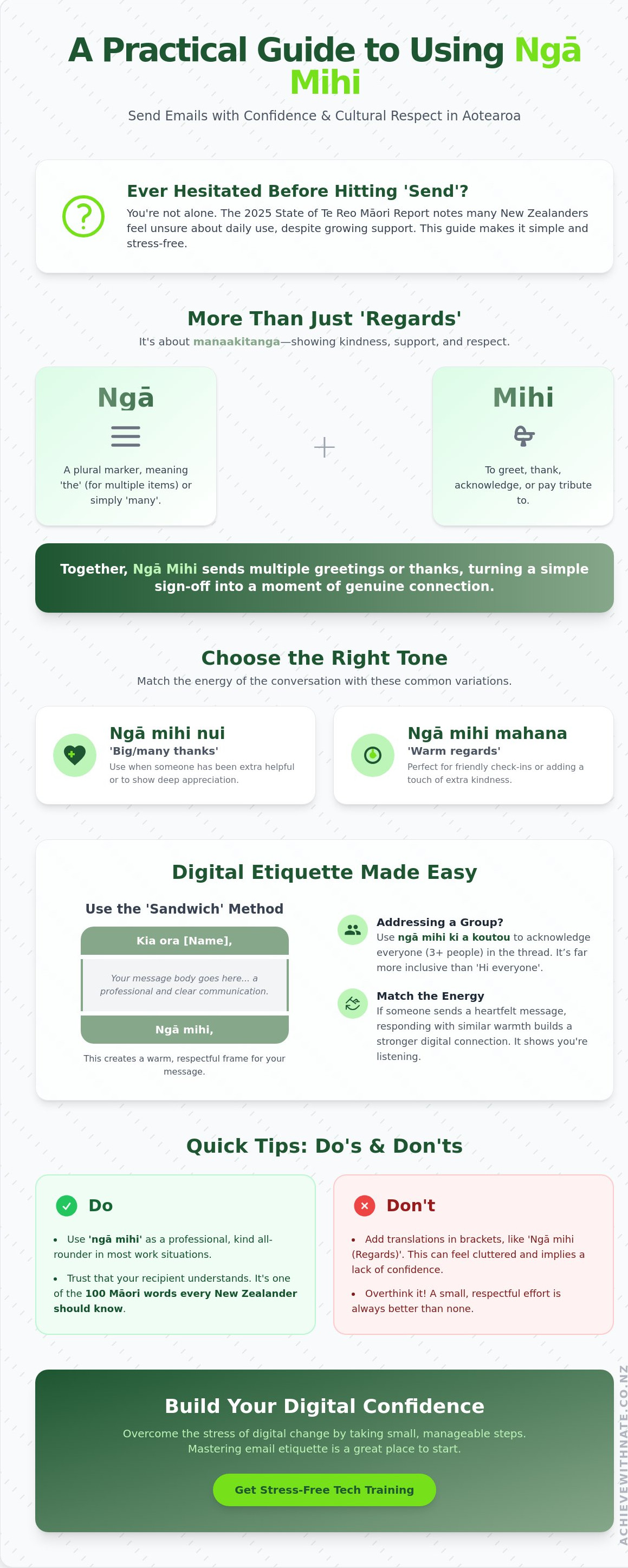
At its simplest, nga mihi is a way to say thank you or send your regards. The word 'ngā' acts as a plural marker, while 'mihi' means to greet, thank, or acknowledge. When you put them together, you are sending multiple greetings or thanks to the person on the other side of the screen. It is a beautiful, versatile phrase that has become a staple in our professional lives here in Aotearoa. This term is foundational to Mihi (Māori culture), where it serves as a way to build connections and show respect. You don't need to be a fluent speaker to use it. It is an inclusive greeting for every Kiwi who wants to communicate with a bit more heart. Using it shows you value our local culture and the person you are messaging.
To better understand how this sounds and feels, watch this helpful video:
Why 'Ngā Mihi' is more than just 'Regards'
Traditional corporate sign-offs like 'Regards' or 'Sincerely' can sometimes feel a bit cold and detached. They get the job done, but they don't always build a bridge. Using nga mihi introduces the concept of manaakitanga into your inbox. This is the practice of showing kindness, support, and respect to others. It turns a standard email into a moment of genuine connection. It's a small change that makes our digital spaces feel much more like home. You are telling the recipient that they matter. This shift from "business as usual" to a more person-centered approach can reduce the stress we often feel in fast-paced digital environments.
Common variations you might see
Once you feel comfortable with the basics, you might notice a few variations in your replies. These allow you to match the energy of the conversation. If a client sends you a very warm message, you can respond in kind. Small adjustments can make a big difference in how your message is received.
Ngā mihi nui: This translates to 'big thanks' or 'many thanks'. Use this when someone has been particularly helpful or you want to show extra appreciation.
Ngā mihi mahana: This means 'warm regards'. It adds a touch of extra kindness to your closing and is perfect for Friday afternoons or friendly check-ins.
Ngā mihi o te ata is the standard for 'good morning' in a digital greeting.
Etiquette: When and How to Use Ngā Mihi Digitally
Using Te Reo in your digital life doesn't have to be complicated. It’s all about the rhythm of the conversation. Many people find success using the 'sandwich' method. You start your email with a friendly 'Kia ora' and end it with nga mihi. This creates a warm, respectful frame for your message without needing to change the entire body of the email. It’s a gentle way to show you’re engaged with our local culture. You don't need to be an expert to make this small, meaningful change.
If you are writing to a group of three or more people, you can use 'ngā mihi ki a koutou'. This acknowledges everyone in the thread at once. It feels much more inclusive than a generic 'Hi everyone'. When you receive a message, try to match the sender's energy. If they send a heartfelt acknowledgement, responding with a similar warmth helps build a stronger connection. It shows you are truly listening. This simple act of matching energy makes digital communication feel much more human.
Professional vs. Casual: Choosing the right mihi
In most work situations, using nga mihi is the perfect all-rounder. It is professional yet kind. If a colleague or client has really helped you out, 'ngā mihi nui' is a great way to show that extra bit of gratitude. This kind of clear, respectful communication is actually a key part of business workflow optimization. When everyone feels respected and understood, things just run more smoothly. It reduces friction in your daily tasks.
Common mistakes to avoid
One thing we often see is people putting translations in brackets, like 'Ngā mihi (Regards)'. You really don't need to do this. Most people in Aotearoa understand the meaning, and those who don't can easily look it up. Adding the translation can sometimes make the message feel a bit cluttered. It is officially listed as one of the 100 Māori words every New Zealander should know, so trust that your meaning is clear. If you ever feel stuck with your email basics, our device and email basics training can help you find your feet.
The Technical Guide: Typing Macrons and Email Signatures
A macron, or tohutō, is that small horizontal line you see over vowels. It might look like a tiny detail, but it plays a big role in our language. It tells the reader to hold the vowel sound a little longer. In the case of nga mihi, the macron over the 'a' shows that the word is plural. This means you are sending many greetings instead of just one. Many people across Aotearoa are now using Ngā mihi in email as a standard, respectful sign-off. Getting the spelling right is a simple way to show you care about the details.
Typing these characters doesn't have to be a struggle. If you use a Windows computer, you can add the Māori keyboard in your language settings. Once it is enabled, you just tap the tilde key (~) followed by the vowel you need. On a Mac, the process is even simpler. Just hold down the vowel key on your keyboard for a second. A small menu will pop up with numbered options, and you can pick the one with the macron. If you are on a mobile device, a long-press on any vowel on your screen keyboard will do the same thing. These are quick, low-pressure tricks that make a big difference.
Setting up a stress-free email signature
You don't need to type out your sign-off every single time you finish a message. To save time and reduce stress, you can save your preferred mihi directly into your Outlook or Gmail signature. This ensures your spelling and macrons are always perfect. We often suggest checking your signature settings as a helpful part of your device and email basics training. It is one less thing to think about when you are busy. If you want to make your digital life even easier, you can book one-on-one digital coaching to get everything set up just right.
What to do if you can't type the macron
There might be times when your technology just won't cooperate. If you are using an older system that makes macrons difficult, don't let it stop you. While 'ngā' technically changes meaning without the line, most people will understand your intent. Respect is found in the effort you make to connect. Use the macron whenever you can, but remember that being kind and inclusive is the most important part of sending nga mihi.
Beyond the Words: Building Your Digital Confidence
Feeling at home in the digital world is about more than just knowing which buttons to press. It is about feeling steady and confident in how you express yourself. We know that tech overwhelm often starts with a small seed of doubt. You might worry about hitting the wrong key or using a phrase like nga mihi incorrectly. These tiny fears can make the digital world feel like a cold or foreign place. But technology should never make you feel inadequate. It is simply a tool to help us reach out to one another. When you use local greetings, you are making that digital space your own.
Nate’s movement is here to help you bridge the gap between knowing a tool exists and actually feeling good while using it. We focus on the person behind the screen. No matter how fast the digital world moves, you can find your footing. Using Te Reo in your emails is a wonderful way to signal that you value connection over perfection. It’s a step toward feeling empowered in your everyday digital life.
Taking small steps toward digital empowerment
We invite you to take one small, manageable action today. Try using nga mihi in your next internal office message or a quick text to a friend. It is a low-stakes way to practice and build your confidence. If the technical side still feels a bit heavy, a digital confidence coach NZ is here to help you with the hard parts. We can work through the basics together until they feel like second nature.
A non-judgmental space for learning
We provide a safe, criticism-free environment for all your technology questions. There are no silly questions here. Your well-being is more important than the software you are using. We want to help you move from a place of distress to a place of empowerment. Technology is just a tool, but the connection you build with others is what truly matters. Take it one step at a time. You are doing great.
Take Your Next Step with Confidence
You now have the tools to bring more warmth and respect to your digital messages. By understanding the heart of nga mihi and mastering the simple way to type macrons, you are already building your digital confidence. These small actions help you feel more at home in our local culture. Technology is just a bridge to help us connect with the people who matter most. It doesn't have to be a source of stress.
If you ever feel overwhelmed by rapid changes, remember that supportive help is always nearby. Nate provides localized help for everyday Kiwis through personalized support for NZ seniors and small businesses. This is a 100% non-judgmental space designed to make learning easy and low-pressure. You don't have to figure it all out on your own. We are here to be your supportive companion on this journey.
Book a calm, one-on-one session with Nate to build your digital confidence today. Taking one manageable step at a time is the best way to move forward. You are doing a wonderful job.
Frequently Asked Questions
Is it appropriate for non-Māori to use 'ngā mihi' in an email?
Yes, it is absolutely appropriate and encouraged for everyone in Aotearoa to use this greeting. Using nga mihi shows you respect our local culture and value the person you are messaging. It is a shared part of our modern business world. You don't need to be Māori to use it. It is a kind way to build a bridge between people and show you care.
How do I type the line over the 'a' in ngā mihi on a laptop?
You can type the line, or macron, by using simple keyboard shortcuts. If you use a Windows laptop, press the tilde key (~) and then the letter 'a'. On a Mac, just hold down the 'a' key for a second and a menu will pop up. You then pick the option with the line. These small tricks make typing in Te Reo feel much easier and more natural for everyone.
What is the difference between 'ngā mihi' and 'ngā mihi nui'?
The main difference is the level of gratitude you want to express in your message. While nga mihi is a perfect all-rounder for any email, 'ngā mihi nui' translates to 'many thanks' or 'big thanks'. Use the 'nui' version when someone has gone out of their way to help you. It adds a little extra warmth to your closing. Matching your greeting to the situation helps your communication feel more human.
Can I use 'ngā mihi' to end a formal business letter?
Yes, this phrase is now a standard and respected sign-off in professional settings across New Zealand. It works well in formal letters because it is both polite and culturally grounded. It has largely replaced older, colder sign-offs like 'Yours faithfully' or 'Sincerely'. Using it shows you are in touch with modern NZ business culture. It is a safe and professional choice for any formal document or email thread.
What happens if I forget the macron when typing ngā mihi?
If you forget the macron, most people will still understand your kind intent and appreciate the effort. Technically, the line over the 'a' makes the word plural, but the most important part is the respect you are showing. Don't let the fear of a small mistake stop you from trying. You can always check your signature settings later. The effort to connect is what truly counts in any digital conversation.


Comments