


Te Whare Tapa Whā: A Practical Guide to Digital Wellbeing for Everyday Kiwis
- kxnath

- Apr 25
- 9 min read
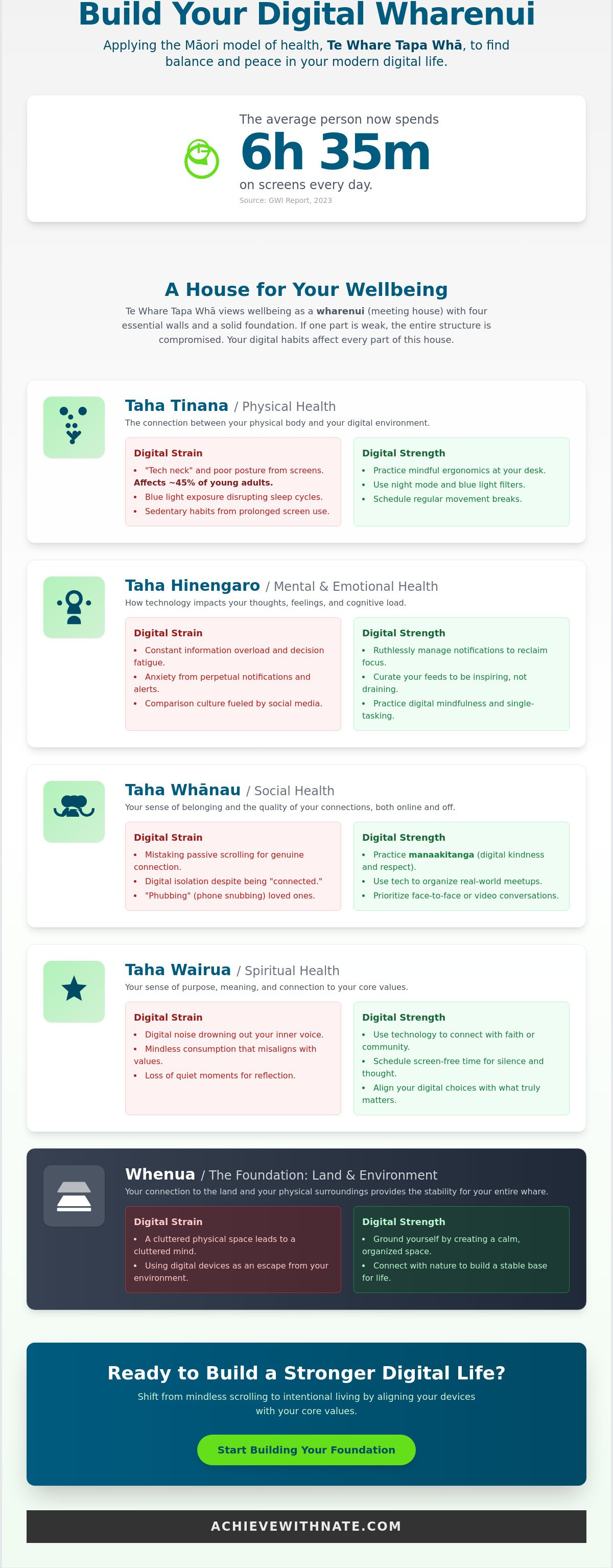
What if the solution to your digital overwhelm isn't a faster phone or a better productivity app? A 2023 report from GWI shows that the average person now spends six hours and 35 minutes looking at screens every day. You likely feel the weight of this constant connection in your own life. It creates a persistent screen fatigue that pulls you away from your whānau and your sense of peace. To find true balance in this noisy environment, we can look to the grounded wisdom of te whare tapa wha.
You deserve a life where your technology supports your values instead of dictating your schedule. This guide will show you how to apply this traditional Māori model to find peace in your modern digital life. You will gain a clear framework to evaluate your habits and take practical steps to reclaim your focus. We are going to explore how to strengthen the four walls of your wellbeing by choosing intentionality over mindless scrolling. It is time to build a digital life that feels as stable and restorative as a well-tended home.
Key Takeaways
Learn how to use the four pillars of te whare tapa wha to build a stable foundation for your digital habits.
Identify how your daily technology use interacts with each specific dimension of your wellbeing.
Perform a "wharenui audit" to remove digital friction and reclaim your focus through intentional subtraction.
Develop the digital confidence required to protect your boundaries from modern online threats.
Shift from mindless scrolling to intentional living by aligning your devices with your core values.
Table of Contents Understanding Te Whare Tapa Whā: The Four Pillars of Wellbeing Mapping the Four Walls to Your Digital Life Practical Steps to Rebuild Your Digital Balance Why Digital Confidence Starts with a Solid Foundation
Understanding Te Whare Tapa Whā: The Four Pillars of Wellbeing
In 1984, Sir Mason Durie developed a model that redefined health for New Zealanders. He moved away from narrow, clinical definitions. Instead, he introduced te whare tapa wha. This model views health as a wharenui, or meeting house. It reminds us that our health is not just the absence of illness. It is a state of total balance.
In 2026, we face unique pressures. Our attention is a commodity. We are often more connected to our screens than to our own bodies. Finding hauora, or holistic wellbeing, requires us to look at the four walls of our house. If one wall is neglected, the entire structure begins to lean. Stability comes from intentional maintenance of every side.
The Wharenui Metaphor: A House for Your Health
The wharenui metaphor is simple and powerful. Each of the four walls represents a different dimension of your life. Taha Tinana is your physical health. Taha Hinengaro focuses on your thoughts and feelings. Taha Whānau covers your social connections and sense of belonging. Taha Wairua relates to your spiritual essence and purpose.
Te Whare Tapa Whā is a holistic framework for health that integrates physical, mental, social, and spiritual wellbeing into a single, unified structure. When you focus only on physical fitness but ignore your mental state, the house lacks balance. You cannot have a strong roof without four sturdy walls. A missing or damaged wall creates a vulnerability that affects every other part of your life.
The Foundation of Whenua: Connection to Place
A house requires a solid foundation to remain upright. In this model, that foundation is Whenua, or the land. It represents your connection to your roots and your physical environment. Your surroundings dictate how you show up in the world. They also influence how you interact with your devices.
Cluttered spaces often lead to cluttered minds. If your home environment is chaotic, you are more likely to seek escape in digital distractions. Grounding yourself in your physical space is the first step toward better digital wellbeing. By respecting the land and your immediate surroundings, you create a stable base for your digital life. This connection provides the clarity needed to use technology with purpose rather than out of habit.
Mapping the Four Walls to Your Digital Life
You might think a traditional Māori health framework cannot possibly account for the complexities of 2024 algorithms. This is a common objection. Yet, the Te Whare Tapa Whā model remains remarkably relevant because it focuses on balance. When your digital habits become "leaky," they drain your energy and weaken the structural integrity of your wharenui. Intentional digital living is the difference between being a passive consumer and a purposeful user.
Taha Tinana & Taha Hinengaro: Body and Mind Online
Your physical health, or Taha Tinana, often suffers first from poor ergonomics. "Tech neck" affects approximately 45 percent of young adults in modern studies, causing chronic strain. Blue light before bed disrupts your circadian rhythm, leading to poor sleep quality. Taha Hinengaro, your mental health, carries the weight of cognitive load. Constant information overload creates a state of perpetual high alert. By managing notifications, you reduce this friction and strengthen your Taha Hinengaro through reclaimed focus. It's about creating a quiet space for your mind to rest.
Taha Whānau: Social Connection vs. Digital Isolation
Technology should strengthen whānau ties, not replace them. We often mistake scrolling for connection. True social health requires manaakitanga, which is the act of showing care and respect in online spaces. If your phone sits between you and your partner at dinner, your social wall is weakening. Use your devices to schedule real-world coffee dates or video call relatives in other cities. If you feel lonelier after using an app, it's a sign of digital isolation rather than genuine connection.
Taha Wairua: Finding Meaning Beyond the Screen
Taha Wairua is your spiritual essence and your sense of purpose. Digital choices must align with your core values to maintain this wall. Silence is a necessary tool for spiritual health. It allows you to disconnect from the noise and reconnect with your own life force. You can use technology for wider communication or faith, but only if it doesn't drown out your inner voice. If you want to build more sustainable systems for your life, you can join our community focused on intentionality. The goal is to ensure your te whare tapa wha remains strong in a digital age.
Practical Steps to Rebuild Your Digital Balance
Your digital life is a direct reflection of your internal wharenui. If one wall is weak, the whole structure feels unstable. Start with a wharenui audit of your current habits. Open your screen time settings and look at the data. Identify which apps leave you feeling drained rather than inspired. The New Zealand Ministry of Health highlights that te whare tapa wha requires all four dimensions to stay in balance for total wellbeing. If your digital habits pull you away from your whānau or your physical health, your house is out of alignment.
Subtraction: The Minimalist Path to a Stronger Wharenui
Most people try to fix digital burnout by adding more productivity tools. This rarely works. True balance comes from subtraction. Delete the apps that trigger mindless scrolling. Set hard boundaries on your notifications. You'll find that doing less online allows you to feel more present offline. It's about removing the friction that keeps you tethered to a screen. When you must use digital tools, focus on quality over quantity. You can use nga mihi to simplify your digital communication. It adds a layer of warmth and respect to your messages without the friction of unnecessary back and forth chatter.
Intentional Systems for Daily Digital Peace
Systems beat willpower every time. Create no-tech zones in your home, especially the dining table and the bedroom. This grounds your wharenui in the physical world. Protect your Taha Tinana by scheduling movement that doesn't involve a device. A simple 20 minute walk at a local park or beach can reset your focus. Use this checklist to maintain your te whare tapa wha balance throughout your day:
Wait 30 minutes after waking before checking your phone.
Turn off all non-human notifications to reduce distractions.
Leave your phone in another room during meals with others.
Set a digital sunset at 9:00 PM to protect your sleep and mental space.
Don't try to change everything at once. Focus on one wall of your wharenui at a time. Small, consistent changes create the most sustainable results for your health. If you want to build a life focused on clarity and freedom, join our community for regular insights on intentional living in Aotearoa.
Why Digital Confidence Starts with a Solid Foundation
Digital skills are more than just tools for work. They are the structural beams of your modern life. When you understand how your devices work, you gain a sense of personal agency. You stop reacting to notifications and start using technology with intention.
Think of your digital life as an extension of te whare tapa whā. If your walls are weak, threats like scams or data breaches can easily break through. Digital capability acts as a protective layer. It keeps your mental and social wellbeing safe from the noise and risks of the internet.
My approach is grounded in practical coaching for everyday Kiwis. I avoid hype and complex jargon. We focus on simple systems that work for you. Using the framework of te whare tapa wha, we can build a digital environment that supports your health instead of draining it.
How Digital Confidence Protects Your Wellbeing
Anxiety often comes from the unknown. When a computer pop-up or a strange email creates fear, your wellbeing suffers. Gaining confidence replaces that fear with clarity. This is vital in a landscape where CERT NZ reported a 13% increase in cybercrime during the final quarter of 2023. Understanding these risks is especially important for seniors who want to stay connected to whānau safely.
Knowing how to use a video call or share photos ensures that your social and emotional walls remain strong. It removes the friction that leads to isolation. If you need a hand getting started, you can explore Nate’s services for personalized support.
Building Your House: Next Steps
Your digital journey is a process of small, consistent actions. It isn't a destination. It's about maintaining your house so it serves you for years to come. You don't have to figure this out alone. Many Kiwis are already simplifying their digital lives to find more peace and focus.
You can join a community of like-minded people who value intentional living over digital clutter. Move away from overwhelm and toward a life of clarity. Take the first step today and join the Digital Confidence journey to reclaim your time and focus.
Build Your Digital Foundation
Your digital life should serve you, not the other way around. By applying the four walls of te whare tapa wha to your screens, you create a sustainable structure for your mental and spiritual health. You've seen how small, intentional shifts in your habits can reclaim hours of your week. Data from the Mental Health Foundation of New Zealand highlights that physical activity and social connection are essential for our collective resilience. Technology often disrupts these foundations.
True digital confidence isn't about mastering every new app. It's about having the discipline to ignore the noise. You can choose a life defined by clarity and focus. My approach focuses on intentional, minimalist living specifically for people living in New Zealand. We strip away the digital clutter to find what truly matters for your long term wellbeing. This is about subtraction, not adding more to your plate.
I provide personalized coaching for everyday Kiwis who want to regain control through a culturally grounded lens. We build simple, effective systems that last. Start your journey toward digital confidence today.
You deserve a life defined by peace, not notifications.
Frequently Asked Questions
What is the main idea of Te Whare Tapa Whā?
The main idea of Te Whare Tapa Whā is that your wellbeing is like a four-sided house. Each wall represents a different part of your health: physical, mental, social, and spiritual. If you neglect one wall, the entire structure becomes unstable. It provides a simple framework to ensure you balance these four dimensions to maintain a strong and healthy life.
Who developed the Te Whare Tapa Whā model?
Sir Mason Durie developed the Te Whare Tapa Whā model in 1984. He presented it to the Maori Women's Welfare League to provide a more holistic view of health. This model changed how New Zealand approaches healthcare by moving beyond just physical symptoms. It remains a vital foundation for health policy in the country today, ensuring that cultural and spiritual needs are met alongside clinical care.
How can I use Te Whare Tapa Whā to improve my mental wellbeing?
You can use the te whare tapa wha model to identify which areas of your life lack balance. Start by assessing your mental wellbeing to see if your thoughts feel cluttered. Often, improving your mental state requires subtracting digital noise. By setting intentional boundaries with your devices, you create the space needed for your mind to rest and recover.
What are the 4 walls of Te Whare Tapa Whā in a digital context?
The four walls are physical health, mental health, social health, and spiritual health. In a digital context, physical health might mean your posture while scrolling. Social health involves using technology to build deep connections rather than shallow interactions. Each wall helps you see how your screen habits impact your overall stability and gives you a clear system for improvement.
Why is the land (whenua) part of the Te Whare Tapa Whā model?
The land serves as the foundation for the four walls of the house. It represents your roots and your connection to the place you call home. Without a solid foundation, the walls cannot stand. For digital wellbeing, this means grounding yourself in the physical world and finding time to disconnect from the virtual one to recharge your spirit.
Can Te Whare Tapa Whā help with digital addiction or screen time?
Te Whare Tapa Whā helps manage digital addiction by highlighting which areas of your life are being neglected for the screen. If you spend 5 hours a day on social media, your physical or social walls likely need repair. Using this system allows you to replace mindless scrolling with intentional actions. It shifts your focus from what you're losing to the balance you're gaining.


Comments