


Understanding Technology Anxiety: A Minimalist Guide for Everyday Kiwis (2026)
- kxnath

- Apr 27
- 10 min read
Last Tuesday, a retired teacher in Napier sat at her kitchen table staring at a new banking app update while her pulse quickened. She felt a familiar weight in her chest. It was a mix of frustration and the fear of making a permanent, costly mistake. This experience is not rare. In fact, a 2024 report by the Citizens Advice Bureau highlighted that many Kiwis feel increasingly excluded by the rapid pace of digital change.
You likely know this feeling well. It's the exhaustion of constant updates and the nagging worry that you might fall victim to a sophisticated scam. Technology should serve you, not the other way around. Living with constant technology anxiety is not a requirement for participating in modern New Zealand life.
You can learn to identify the roots of your digital stress and reclaim your confidence with intentional, simple systems. This guide will show you how to strip away the noise. We will look at practical ways to manage your digital tasks so you can find a sense of peace when using your devices again.
Key Takeaways
Learn to distinguish between general digital stress and technology anxiety to better understand the root of your discomfort.
Uncover why the "Black Box" effect and rapid update cycles create a sense of instability in your daily life.
Adopt a minimalist mindset by focusing only on the digital tools and systems that offer you genuine value.
Discover the "Safe Failure" method to build your confidence and explore new devices in a low-stakes environment.
Understand how intentional coaching provides the calm, patient support you need to reclaim your digital freedom.
Table of Contents What is Technology Anxiety and Why Does it Affect Kiwis? The Root Causes of Your Digital Overwhelm 4 Practical Steps to Reduce Technology Anxiety Reclaiming Your Digital Freedom with Coaching
What is Technology Anxiety and Why Does it Affect Kiwis?
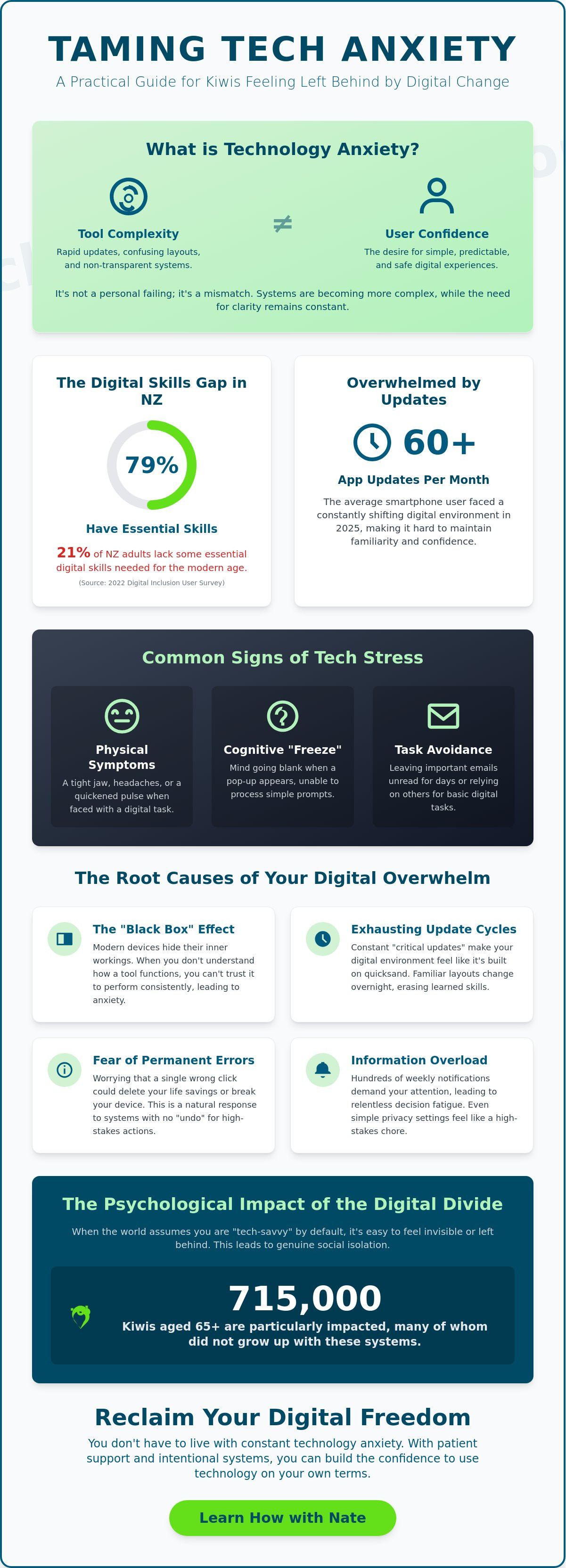
Technology anxiety is the discomfort you feel when digital tools become a barrier rather than a bridge. It's the quiet tension in your shoulders when a software update changes your familiar layout. Simply put, technology anxiety is a mismatch between tool complexity and user confidence.
You might wonder if you have a clinical phobia. Most people don't. Clinical technophobia is an intense, irrational fear that requires professional help. What most Kiwis face is a more common form of What is Technostress, which stems from the rapid pace of digital change. It's a rational response to a world that feels like it's moving too fast.
In New Zealand, this feeling is valid. The 2022 Digital Inclusion User Survey showed that 21 percent of adults lack some of the essential skills needed for the digital age. When your local bank branch closes and moves everything to an app, the digital divide feels personal. It's not just a statistic; it's your daily life. You aren't failing; the systems around you are simply becoming more complex.
Signs You Might Be Experiencing Tech Stress
Your body often notices technology anxiety before your mind does. You might experience physical symptoms like a tight jaw or headaches when you sit down to do your online banking. Avoidance is another major sign. You might leave an important email unread for days because the platform feels overwhelming.
Cognitive signs are also common. You might feel "frozen" when a simple pop-up appears on your screen. Instead of reading the prompt, your mind goes blank. You might also find yourself relying on your children or neighbors to perform basic tasks. This behavioral shift often leads to a loss of agency and a feeling of being stuck in outdated methods.
The Difference Between Fear and Lack of Confidence
There's a significant difference between being unable to learn and simply not knowing how yet. Many people mistake a temporary lack of skill for a permanent character flaw. This isn't true. Learning a digital tool is a habit, not an innate talent.
Intentional living starts with acknowledging your current skill level without judgment. When you lack digital confidence, your independence suffers. You might pay more for services because you can't access "online-only" discounts. You might miss out on community events shared only through social media. Gaining clarity on what you don't know is the first step toward reclaiming your freedom.
The Root Causes of Your Digital Overwhelm
You feel it because the tools you use are no longer transparent. Most modern devices act as "black boxes." You see the sleek screen and the icons, but you don't understand the mechanics underneath. This lack of control and understanding is a primary driver of technology anxiety. When you don't know how a tool works, you can't trust it to perform consistently.
Stability is rare in the current digital climate. Software companies now push "critical updates" at an exhausting pace. In 2025, the average smartphone user dealt with over 60 app updates per month. This constant shifting makes your digital environment feel like it is built on quicksand. You also face the fear of permanent errors. You worry that a single wrong click will delete your life savings or break your computer forever. This isn't irrational; it's a natural response to systems that offer no "undo" button for high-stakes actions.
Information overload further paralyses your ability to make simple choices. Your phone sends hundreds of pings every week, each demanding a slice of your limited attention. Research shows how technology is causing anxiety through this relentless decision fatigue. Choosing a simple privacy setting shouldn't feel like a high-stakes chore, yet modern systems make it so.
Why Modern Design Feeds Our Anxiety
Interfaces often use "dark patterns." These are intentional design tricks that make it difficult to cancel a subscription or find a simple "off" switch. As New Zealand banks and government agencies like MSD move services exclusively online, the friction increases for everyone. This shift creates a significant barrier for those who value physical interaction and clear, simple processes. Prioritising digital wellbeing is now a survival skill for the modern Kiwi.
The Psychological Impact of the Digital Divide
The world often assumes you are "tech-savvy" by default. If you aren't, you might feel invisible or left behind. This digital divide leads to genuine social isolation, particularly for the 715,000 Kiwis aged 65 and over who may not have grown up with these systems. New developments in artificial intelligence nz add another layer of uncertainty to an already crowded mental space. It's a heavy burden to carry alone.
If you want to reclaim your peace of mind and simplify your digital life, you can learn more about my approach to intentional living and minimalist systems.
4 Practical Steps to Reduce Technology Anxiety
Technology anxiety often grows from the false belief that you must master every new gadget. You don't. A minimalist approach focuses on utility over novelty. If a tool doesn't improve your life, it's just noise. By applying intentional systems, you can move from a state of worry to a state of control.
Practice Safe Failure. Spend 15 minutes clicking through a new app when you have nothing else to do. There's no risk of missing a deadline or breaking the device. This low-stakes exploration builds muscle memory and removes the fear of the unknown.
Standardize your systems. Use the same logic for your phone, tablet, and computer. If you organize your photos into yearly folders on your PC, do the same on your cloud storage. Consistency reduces the mental load of switching between different platforms.
Focus on subtraction. Most digital stress comes from clutter. Statistics from 2025 suggest that 65 percent of notifications are non-essential. Go into your settings and turn off everything except calls and direct messages. A clean screen leads to a clean mind.
Adopt a "need to know" mindset. You don't need to understand the complex code behind an app to use it. Focus only on the specific buttons required to complete your task. Ignore the rest of the interface until you actually need it.
Developing an Intentional Digital Routine
Boundaries are your best defense against feeling overwhelmed. Set specific times to check emails or news rather than reacting to every buzz. Avoid the trap of "just-in-case" learning, where you study features you might never use. Instead, embrace "just-in-time" learning. Only seek out information when a specific task requires it. This keeps your mind clear and your focus sharp. Use a physical notebook to write down steps for tricky tasks like accessing RealMe or MyMSD. Having a manual backup reduces the fear of getting locked out of essential services.
Building a Support Network
Asking for help is a sign of agency, not weakness. However, many Kiwis find that asking family members leads to more frustration. Relatives often move too fast or lack the teaching structure required for adult learners. Professional digital confidence coaching offers a calm, systematic way to build skills. It removes the emotional weight of "bothering" someone you know. Build a Tech Toolkit that includes official support numbers and your own written guides. Having these resources ready provides a safety net for your confidence.
Take the first step toward a simpler digital life. Learn more about intentional systems and coaching to gain the clarity you deserve.
Reclaiming Your Digital Freedom with Coaching
Traditional IT support focuses on the hardware. It fixes a cracked screen or a slow internet connection. Digital coaching is different because it focuses on you. When technology anxiety takes hold, the solution isn't just a software update. It's a shift in how you relate to your devices. You need a quiet space where you can ask questions without feeling behind or overwhelmed.
The Achieve With Nate approach is grounded in patience. I provide a calm environment where we strip away the noise of the digital world. We don't chase every new app or trend. Instead, we build a tailored system that works for your specific lifestyle. Moving from anxiety to agency means you no longer react to your phone with dread. You start to use it as a purposeful tool for your own goals.
Developing digital skills is a modern form of self-reliance and freedom. It allows you to navigate the world on your own terms without relying on others for every small task.
What to Expect from Digital Confidence Coaching
Our sessions are strictly personalized. We move at your pace. There is no judgment and no rush. We focus on essential life skills that provide immediate relief. This might include setting up secure logins or learning how to navigate essential NZ services like MyMSD and Health NZ portals. You can learn more about Nate and his mission to help everyday Kiwis find digital clarity.
One-on-one guidance tailored to your current skill level.
Practical steps to protect your privacy and data.
A focus on the tools you actually use, not the ones you don't.
Taking the First Step Toward Confidence
Confidence starts with identifying your high-value digital goals. These are the actions that matter most to your well-being. For many Kiwis, it's the ability to video call grandchildren overseas. For others, it's the peace of mind that comes from managing bank accounts securely. We identify these priorities first to ensure your progress feels meaningful and relevant to your life.
The process is simple and transparent. We start by looking at where you feel stuck. Then, we create a clear path to remove that friction. You don't need to be a "tech person" to feel in control. You just need a reliable system that respects your time. If you're ready to feel more capable and less stressed, submit an expression of interest today. It's time to reclaim your peace of mind.
Build a Sustainable Relationship With Your Devices
Technology anxiety is a common response to the digital noise of 2026. You don't have to accept overwhelm as a permanent part of your life. We've seen that reclaiming your time starts with intentional subtraction and simple, repeatable systems. By focusing on practical life skills, you can move from a state of constant distraction to one of quiet clarity.
Real change happens when you stop seeking more tools and start refining your existing habits. My personalized coaching is designed for everyday Kiwis who value peace over status. I use a calm, minimalist teaching style to help you navigate the digital landscape without the usual stress. We focus on what truly matters to your lifestyle and your long-term freedom.
Success isn't about mastering every new app. It's about building a life where you're in control. Join the journey to digital confidence today. You're capable of creating a focused, intentional future.
Frequently Asked Questions
Is technology anxiety a real mental health condition?
Technology anxiety isn't currently listed as a formal clinical diagnosis in the DSM-5, but it's a recognized psychological state. A 2023 study from the University of Auckland found that 42% of Kiwis experience stress when faced with rapid digital changes. You aren't alone if you feel physical tension or a desire to avoid your devices. It's a natural response to a complex system that often lacks clarity.
How do I overcome my fear of breaking my computer or phone?
You can overcome this fear by establishing a simple recovery system. Modern devices use sandboxed software, which means one wrong click won't destroy the hardware. Set up an automated cloud backup for roughly NZ$2.99 per month to protect your photos and documents. This safety net provides the freedom to explore your device. When you know your data is safe, the fear of a mistake disappears.
Can older adults really learn new digital skills effectively?
Older adults can master new skills by focusing on one intentional habit at a time. Data from Age Concern New Zealand shows that 68% of seniors now use the internet daily to manage their affairs. Success doesn't require technical expertise. It requires a repeatable system. You don't need to learn every feature. Focus only on the tools that add direct value to your life and ignore the rest.
What is the best way to deal with a confusing software update?
The most effective strategy is to wait 48 hours before installing any non-urgent update. This window allows developers to fix initial bugs reported by early adopters. When you do update, look for the three most important changes and ignore the fluff. Minimalism applies to your software too. If a new feature doesn't serve your purpose, you don't have to use it or understand it.
How can I tell if I need professional digital coaching?
You might need professional support if technology anxiety stops you from completing essential tasks for more than three days a week. If you spend over 90 minutes a day feeling frustrated by your tools, a coach can help. They provide a structured system to reduce friction in your digital life. This investment is about buying back your time and finding peace in a noisy digital world.
What should I do if I feel overwhelmed by too many apps?
Practice digital subtraction by deleting any app you haven't opened in the last 30 days. Statistics show the average person only uses 9 apps regularly despite having over 30 installed. Reducing this clutter creates immediate mental clarity. Keep your home screen intentional by only showing the tools you use daily. Removing the noise allows you to focus on what truly matters in your life.


Comments