


What is AI? A Calm and Simple Guide for Everyday Kiwis

Updated: Apr 20
What if the technology everyone is shouting about is actually just a simple tool for intentional living? You've likely seen the headlines and felt a bit left behind. It's common to feel that things are moving too fast. You might even wonder: what is ai, and does it really matter for my life here in New Zealand?
You're right to be cautious of the hype. A 2024 report from Microsoft showed that 71% of leaders now prefer to hire candidates with digital tool skills. This can feel daunting if you don't have a technical background. I want to help you understand the basics without the jargon or the fear of a robotic takeover.
This guide is here to clear the noise. We'll break down how these systems work and how they already affect your daily routine. By the end, you'll have the clarity you need to use these tools with confidence. Let's find a way to make this technology work for you.
Key Takeaways
Learn what is ai by viewing it as a digital apprentice that learns from patterns rather than rigid rules.
Strip away the technical jargon and understand how simple information helps software make helpful decisions.
Recognize the systems you already use every day to filter noise and find clarity in your digital life.
Focus on using these tools intentionally to support your focus rather than feeling overwhelmed by the tech.
Gain the confidence to navigate new technology with a calm and grounded Kiwi perspective.
Table of Contents What is Artificial Intelligence (AI) in Simple Terms? How AI Actually Works Without the Technical Jargon Everyday Examples of AI You Are Already Using Building Your Digital Confidence with AI
What is Artificial Intelligence (AI) in Simple Terms?
You've likely heard the term "AI" mentioned in the news or around the dinner table lately. It's often surrounded by hype or fear, which can make it feel more complicated than it actually is. At its core, AI is simply a type of software. Unlike the programs we've used for decades, it doesn't just follow a fixed list of instructions. Instead, it learns by identifying patterns in data.
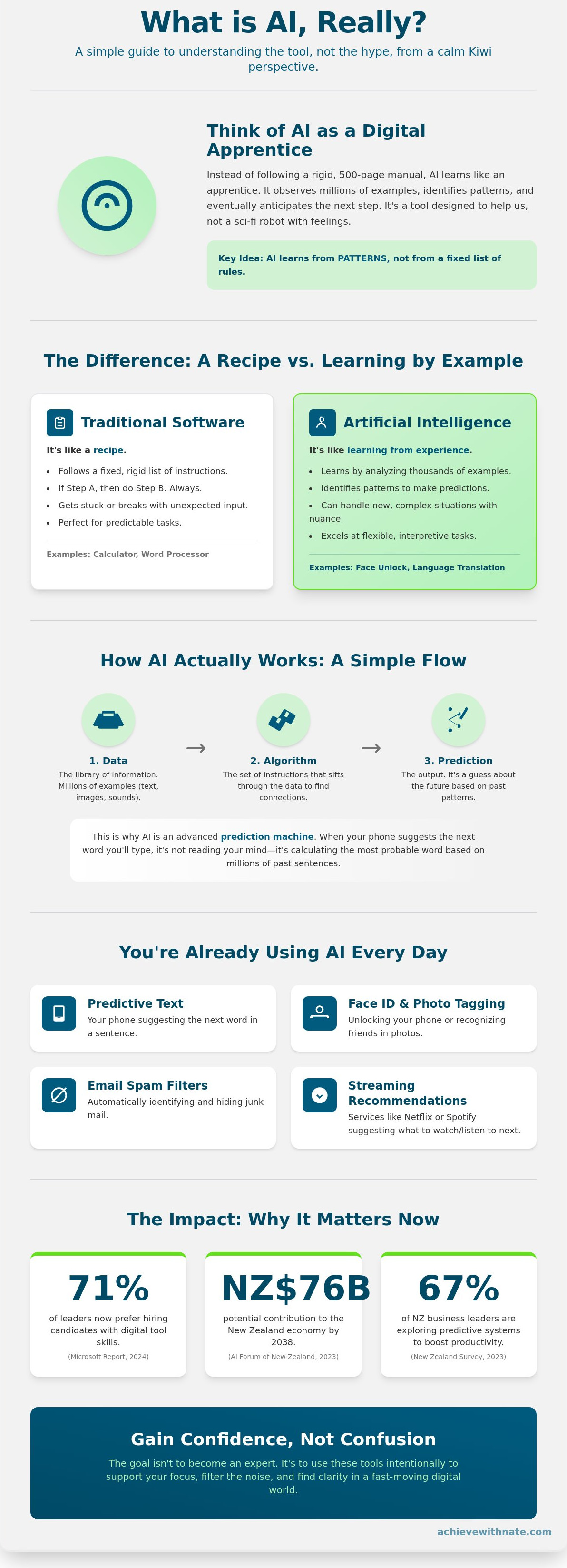
Think of AI as a digital apprentice. When you hire an apprentice, you don't give them a 500-page manual for every possible scenario. You show them how you work, let them observe, and they eventually learn to anticipate the next step. This is a helpful way to understand what artificial intelligence is in a practical sense. It's a tool designed to help us, not a sentient robot from a sci-fi movie. It doesn't have feelings, a soul, or the ability to "think" for itself in the way you do.
Many people confuse "digital" with "AI." If you use a calculator to add numbers, that's digital, but it's not AI. The calculator follows a strict rule. If you use an app that recognizes your face to unlock your phone, that's AI. It has looked at thousands of faces to learn what a human face looks like. Understanding what is ai helps you see it as a system built for efficiency and clarity.
The Difference Between a Standard Computer and AI
Traditional software is like a recipe. If the computer follows steps A, B, and C, it gets result D. This works perfectly for spreadsheets or word processors. However, recipes are rigid. If something unexpected happens, the software gets stuck.
AI is different because it learns through examples. Instead of being told exactly what a cat looks like, it's shown 100,000 photos of cats. It notices the patterns of ears, whiskers, and fur. This flexibility allows it to handle complex tasks like translating languages or recognizing voices with a level of nuance that older computers couldn't manage.
Why Everyone is Talking About AI in 2026
The conversation changed rapidly after November 2022 when tools like ChatGPT became public. By 2026, these systems have become even more integrated into our daily lives. We call this "Generative AI" because it can create new things, like text, images, or code, that feel remarkably human.
It's natural to feel overwhelmed by how fast things are moving. The technology has shifted from being a technical background process to something you can actually talk to. While the speed of change is high, the goal remains the same. It's about using better systems to find more freedom and focus in your day. What is ai at its best? It's a way to simplify the noise of the digital world.
How AI Actually Works Without the Technical Jargon
To understand what is ai, you first need to grasp two basic concepts: algorithms and data. An algorithm is just a set of instructions. It is a simple decision-making rule, similar to a recipe for a basic batch of scones. Data is the library of information the algorithm uses to learn those rules. Without data, the algorithm has nothing to process.
Think about how a child learns to identify animals. You show them a cat and say, "That is a cat." You show them a dog and say, "That is a dog." After seeing enough examples, the child recognizes the patterns. They know a cat has certain ears and a dog has a different tail. AI follows this exact logic. It processes millions of examples to find the "shape" of an idea.
AI is only as good as the information we provide. If we give it biased or poor data, the results will be flawed. Understanding how AI actually works helps remove the mystery. It is a tool built on logic and systems, not magic. According to a 2023 report from the AI Forum of New Zealand, AI technologies could contribute NZ$76 billion to the local economy by 2038 if we use them effectively.
The Role of Patterns and Predictions
AI is essentially an advanced prediction machine. It looks at history to guess the future. You see this every day with predictive text on your smartphone. When you type "How are," your phone suggests "you" because it has seen that pattern millions of times before. It isn't reading your mind; it is calculating the most likely next word.
Machine learning is a system that improves its accuracy as it gains more experience. It doesn't require a human to rewrite the code every time it makes a mistake. Instead, it adjusts its own internal rules based on new data. A 2023 survey found that 67% of New Zealand business leaders are already looking at these predictive systems to improve their daily productivity.
Generative AI: Creating New Things from Old Information
When people ask what is ai in the context of tools like ChatGPT, they are usually talking about Generative AI. These systems can create text or images by mixing patterns they have already seen. The AI isn't "thinking" in the way humans do. It is predicting the next logical word or pixel based on its training. It is a sophisticated mimic.
This process requires human oversight. Since the AI is just calculating probabilities, it can sometimes produce errors or "hallucinations." You must remain the director of the system. If you want to build more intentional systems in your own life, understanding these tools is a great first step toward clarity and focus.
Everyday Examples of AI You Are Already Using
You don't need to look far to see what is ai in action. It's likely sitting on your kitchen bench or in your pocket right now. Most of us use these systems daily without a second thought. They aren't futuristic concepts; they are practical tools designed to create more space in our lives.
Email Spam Filters: Your Gmail or Outlook inbox stays clean because AI recognizes patterns in junk mail. It filters out 99.9% of spam before you even see it. It learns which senders you trust and which ones are trying to clutter your digital space.
Streaming Services: When you finish a show on Netflix or YouTube, the next suggestion isn't a random choice. Understanding Carnegie Mellon University's guide to AI helps clarify how these systems learn from your data to make decisions that feel personal and relevant to your tastes.
Navigation Apps: Google Maps doesn't just show a map. It predicts traffic based on millions of data points from other drivers. It suggests a faster route home to Auckland or Christchurch in real-time, helping you avoid congestion and save fuel.
Online Banking: NZ banks use AI to protect your money. If a transaction looks unusual or occurs in a different country, the system flags it instantly. This keeps your hard-earned NZD safe from fraud without you having to monitor every single cent yourself.
Digital Assistants: Siri and Alexa use natural language processing. They translate your voice into code to set a timer or play music. These assistants get better at understanding your specific accent and habits over time.
When you ask what is ai, the answer is often found in these quiet systems that work in the background. They are built to handle repetitive tasks so you don't have to.
AI in Your Pocket: The Smartphone Connection
Your phone camera does a lot of heavy lifting behind the scenes. It uses AI to adjust lighting and focus the moment you tap the shutter. This ensures your photos look clear even in poor light. Voice-to-text features also rely on complex models to turn your speech into written words instantly. Mastering these small tools is a simple step toward building digital confidence in your daily life.
How AI Simplifies Modern Daily Tasks
Smart appliances now learn your home routine to save energy. A smart thermostat might lower the heat when it knows you've left for work. This is a form of intentional lifestyle design. It removes friction from your day and reduces your monthly bills. Online shopping sites use similar logic to show you products that fit your specific needs. These systems save you time. They allow you to focus your energy on what truly matters.
Ready to simplify your digital life? Join my newsletter for intentional living tips.
Building Your Digital Confidence with AI
You don't need to be a computer scientist to benefit from this technology. When people ask what is ai, they often get lost in complex technical jargon. It's more helpful to think of it as a tool, much like a calculator or a microwave. You don't need to understand the internal circuitry to make it work for you. Your goal isn't to master the code; it's to use the tool intentionally to create more space in your daily life.
Curiosity is your best asset in this changing landscape. When you approach these tools with an open mind rather than fear, you gain agency. Digital literacy isn't about knowing everything. It's about knowing you have the power to choose which tools serve your goals and which ones to ignore. This mindset shifts you from a passive observer to an intentional user.
Staying Safe and Intentional Online
Digital safety starts with your own judgment. AI can be incredibly helpful, but it isn't always accurate. A 2023 study by Purdue University found that certain AI models answered software engineering questions incorrectly 52% of the time. This is why critical thinking remains the most important human skill. You stay in control by verifying the information you receive.
Check for logic. Does the answer sound too perfect or slightly robotic? Trust your gut if something feels off.
Verify the sources. If the AI provides a fact, do a quick search to see if a reputable New Zealand news site or government agency confirms it.
Look for generic phrasing. AI often speaks in broad strokes. If the advice lacks personal nuance or specific local context, treat it as a starting point only.
You are always the one in the driver's seat. These systems are designed to assist you, not replace your own common sense. If a tool feels overwhelming or intrusive, you have the right to step away from it.
Taking the Next Step in Your Digital Journey
Confidence grows through small, consistent actions. You don't have to overhaul your entire life overnight. Start by using one app to help with a single task, like organizing a budget or drafting a difficult email. This small win builds familiarity without the stress of "learning" a whole new field.
At Achieve With Nate, we focus on bridging the gap between complex tech and simple, intentional living. We believe that understanding what is ai should lead to more freedom and clarity, not more clutter. If you feel stuck or unsure where to begin, you aren't alone. You can book a coaching session to get personalized support tailored to your specific lifestyle. Let's make the digital world work for you, one simple step at a time.
Moving Forward with Digital Confidence
Technology moves fast, but you don't have to feel left behind. We have looked at how these systems work and why they matter to everyday Kiwis. You now know that AI is simply a tool designed to recognize patterns and assist with daily tasks. From the GPS on your phone to the recommendations on your screen, these systems are already part of your life. Understanding what is ai is the first step toward intentional living in a digital age.
It's about subtraction. By removing the fear of the unknown, you can focus on what truly matters. According to the 2023 Digital Skills Aotearoa report, confidence remains a primary barrier to digital agency for many New Zealanders. You have the power to decide how these tools serve your goals. Real growth comes from consistent, simple actions. You can choose to use technology with purpose rather than being overwhelmed by it. This calm, minimalist approach ensures you stay in control of your digital environment.
You have everything you need to navigate this space with clarity and peace.
Common Questions About AI in New Zealand
Is AI going to replace human jobs in New Zealand?
AI will likely change how you work rather than simply replacing your role. A 2023 report from the NZ Productivity Commission suggests that while 31 percent of tasks could be automated, new roles will emerge. Focus on using these systems to handle repetitive tasks so you can focus on high-value human work. This approach creates more freedom in your daily schedule and allows for more intentional career growth.
Do I need to be a "math person" or "tech expert" to use AI?
You don't need a technical background or a degree in mathematics to use these tools. Most modern platforms are designed for natural language. If you can send a text or write a basic email, you have the skills required to start. It's about clear communication rather than coding. This accessibility is why understanding what is ai has become essential for Kiwis looking to simplify their daily systems.
Is my personal data safe when I use AI tools?
Your data safety depends on the specific tool and its privacy settings. Companies like OpenAI and Google provide clear opt-out options in their settings menus to prevent your data from being used for training. Always check the privacy policy of any tool you use. In 2023, the New Zealand Office of the Privacy Commissioner released specific guidelines for businesses to ensure they protect individual rights when using these systems.
How can I tell if a photo or email was made by AI?
Look for subtle inconsistencies in the details. In photos, AI often struggles with human hands, often rendering six fingers or blurred textures. For emails, look for a tone that feels overly formal or generic. While 63 percent of people in a 2023 study struggled to identify AI text, staying observant of these small patterns helps you maintain clarity and awareness. Trust your intuition when something feels slightly off.
What is the best way for a beginner to start learning about AI?
Start by using a free tool like ChatGPT or Microsoft Copilot for a simple, real-world task. Ask it to help you plan a meal using the ingredients in your pantry or to draft a polite response to an invitation. This hands-on approach removes the mystery. Learning what is ai through direct practice is more effective than reading complex theories. It allows you to see the practical value in your own life.
Can AI actually think or feel like a human?
No, AI doesn't have feelings, consciousness, or the ability to think independently. It uses complex mathematical patterns to predict the next word or pixel in a sequence based on the massive datasets it was trained on. It's a system for processing information, not a living being. Understanding this distinction helps you use these tools intentionally. You can appreciate the efficiency without worrying about the machine having human-like motivations.


Comments