


Digital Wellbeing: A Practical Guide for Everyday Kiwis in 2026

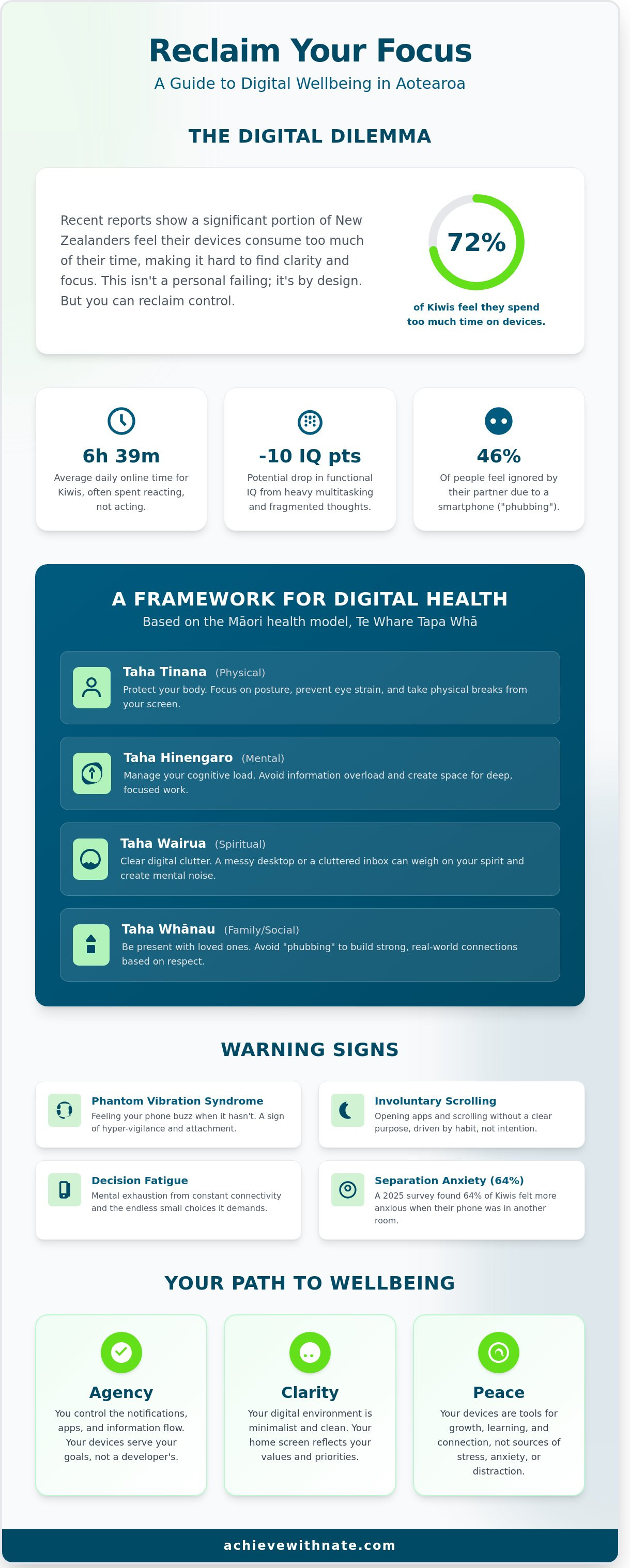
What if your smartphone was a tool you chose to use, rather than a master that demanded your attention every 4 minutes? You likely know the feeling of sitting at a playground or a cafe, only to find yourself scrolling through work emails instead of being present. It's a common struggle. Recent reports suggest that 72 percent of New Zealanders feel they spend too much time on their devices. This constant noise makes it difficult to find clarity or focus on a single task. Prioritizing your digital wellbeing is no longer a luxury. It's a necessity for a peaceful, intentional life in 2026.
You deserve to feel a sense of agency over your devices. I've spent years testing these systems to ensure they actually work in a busy world. I'll show you how to reclaim your focus and use technology with intention through simple, sustainable habits. This guide breaks down the process of auditing your digital environment. We will explore how to subtract the noise, set boundaries that stick, and use tools to support your goals rather than drain your energy. It's time to find a better way to live alongside our screens.
Key Takeaways
Shift your focus from screen time metrics to a more intentional relationship with your devices.
Protect your attention from the distraction economy by building simple, sustainable systems.
Enhance your digital wellbeing through the power of subtraction and notification audits.
Understand how habits like doomscrolling affect your perspective and your local Kiwi community.
Gain the confidence to learn new skills by reclaiming intentional control over your technology.
Table of Contents
What is Digital Wellbeing in a Kiwi Context?
Digital wellbeing is the intentional relationship you build with your devices. It isn't about counting minutes on a screen. It's about personal agency. You decide how your phone serves you. In 2026, we know that screen time is a flawed metric. Ten hours spent learning a new skill is not the same as three hours of mindless scrolling. True digital health focuses on how you feel after you put the device down. It's about preserving your mental clarity and daily peace. You aren't a victim of algorithms. You are the architect of your digital environment.
The Four Walls of Digital Health
Te Whare Tapa Whā provides a solid framework for your online life. Taha Tinana (physical) involves your posture and eye health. Taha Hinengaro (mental) is about managing your cognitive load and avoiding information overload. Digital clutter impacts Taha Wairua (spiritual). A cluttered inbox or a messy desktop creates a heavy spirit. Taha Whānau (family) suffers when we are "phubbing" our loved ones. Real connection requires presence. Sometimes you need to understand what is a digital detox to reset these boundaries and find balance again.
Signs Your Digital Wellbeing Needs Attention
Watch for "phantom vibration" syndrome. This is when you feel your phone buzz even when it's not in your pocket. It's a sign of hyper-vigilance. Involuntary scrolling is another red flag. If you open an app without a clear purpose, your systems are failing. Constant connectivity leads to decision fatigue. A 2025 survey of 1,200 New Zealanders found that 64% of people felt more anxious when their phone was in another room. Feeling "behind" on new tech isn't about your intelligence. It's a symptom of poor systems. You don't need every new app. You need a setup that works for your life.
Agency: You control the notifications, they don't control you.
Clarity: Your home screen should reflect your values, not a developer's goals.
Peace: Your devices should be tools for growth, not sources of stress.
By treating your digital life with the same respect as your physical home, you create space for what matters. This is the foundation of digital wellbeing in a modern Aotearoa.
Why Intentional Tech Use Matters for Your Focus
Your attention is the most valuable commodity in the modern economy. Global tech giants employ thousands of engineers to design interfaces that keep you scrolling. They use variable reward schedules to trigger dopamine hits. This keeps you tethered to your screen. It is not a fair fight. You need a system to protect your time.
Research indicates that heavy multitasking can lower your functional IQ by 10 points. It fragments your thoughts and reduces your ability to engage in deep work. Reclaiming your mental quiet space is essential for long term peace. Current scientific research on digital wellbeing shows that excessive screen time correlates with increased anxiety and decreased life satisfaction across all age groups.
Kiwis spend an average of 6 hours and 39 minutes online every day. Much of this time is spent reacting to notifications rather than pursuing personal goals. When you react, you aren't in control of your life. Choosing to be intentional means you decide when and why you pick up your phone. It is about moving from a state of constant distraction to a state of deliberate action.
Reclaiming Your Mental Clarity
Deep focus is a rare superpower. When you work without interruptions, you enter a flow state. This leads to better results in less time. Digital minimalism isn't about hiding from the world. It is about removing the noise so you can hear your own thoughts. This practice lowers cortisol levels and increases your daily sense of calm.
Intentionality is the choice to use technology as a specific tool for your goals rather than a default distraction from your life.
Building simple systems for focus helps you maintain this clarity throughout the day.
Strengthening Real-World Connections
Phubbing, or phone snubbing, is damaging New Zealand relationships. A 2023 study found that 46 percent of people felt ignored by their partner because of a smartphone. This behavior erodes trust. It makes the people in front of you feel less important than a random notification.
Being present improves your whānau interactions. Your children and partner deserve your full attention. Set a clear standard for digital etiquette in your home. This might mean no phones at the dinner table or during evening conversations. You create a culture of respect and connection when you put the device away and focus on the person in front of you.
Common Digital Habits That Drain Your Energy
Living in a state of constant availability is a modern myth that carries a heavy price. Your nervous system is not built to be "on" for 16 hours a day. When you feel the need to respond to every message instantly, your body remains in a state of high cortisol. This habit erodes your digital wellbeing and leaves you feeling depleted by midday. True productivity requires periods of being unreachable.
Doomscrolling is another subtle energy thief. A 2023 report indicated that Kiwis spend an average of 2 hours and 11 minutes on social media daily. Much of this time is spent consuming negative global news. This habit shifts your focus away from your immediate community in New Zealand. It colors your world with unnecessary anxiety. You lose the ability to appreciate the quiet, tangible moments in your own life.
Free apps are rarely free. They trade your focus for advertising revenue. Every "free" game or social tool costs you mental energy through targeted distractions. Choosing to pay for a quality tool or simply doing without it is often the more intentional choice. You should value your attention more than a few dollars saved on a subscription.
The Trap of Constant Notifications
Your brain interprets a red notification badge as a survival threat. This triggers a micro-dose of stress every time your phone lights up. To regain control, you must shift from "push" to "pull" information gathering. This means you decide when to check for updates rather than letting the device interrupt your focus. You can find practical digital wellbeing tips to help you audit which alerts are essential. Most people find that 90% of their notifications are merely noise.
Digital Clutter and Decision Fatigue
A messy inbox is just as draining as a cluttered kitchen. If you have 5,000 unorganized photos and 20 open browser tabs, you are carrying a heavy cognitive load. Each item represents an unfinished task or an unmade decision. A clean digital environment mirrors a clean physical home. It provides the clarity you need to focus on your goals. Aim for one trusted system for your files. Minimalism in your digital life creates space for peace. You don't need more storage; you need less clutter.
Practical Steps for a Balanced Digital Life
Digital wellbeing starts with subtraction. You don't need a new app to manage your time. You need fewer distractions. Open your phone and look at every icon. If an app doesn't align with your core values or provide tangible utility, delete it. A 2023 study showed that the average user has over 80 apps installed but only uses 30 of them regularly. These unused apps are just clutter. They compete for your attention through red badges and pings.
Audit your notifications with a simple rule. Only humans should have the right to interrupt you. Disable alerts for likes, news updates, and promotional offers. Keep notifications active only for direct messages or phone calls from real people. This shift ensures you use your device on your terms. You're no longer reacting to an algorithm. You're responding to your community. Establish tech-free zones in your home, such as the dining table or the bedroom. In New Zealand, 42 percent of workers report that digital connectivity makes it harder to switch off after work. Creating physical boundaries is the only way to protect your mental space.
Simplifying Your Smartphone
Adopt the one-screen rule for a minimalist mobile experience. Keep only your most essential tools on your primary home screen. This might include your calendar, maps, and camera. Move everything else into the app library or hidden folders. This friction prevents mindless tapping. Use Focus Modes to automate your boundaries. You can set your phone to "Personal" mode from 5:30 PM, which silences work emails and Slack notifications automatically. Keeping your home screen intentional reduces the cognitive load every time you unlock your device.
Intentional Habits for Daily Life
Your morning sets the tone for your day. Avoid your phone for the first 30 minutes after waking up. This digital-free window allows you to ground yourself before the world's demands rush in. Set "office hours" for your personal digital life. Check social media or personal emails only at 10:00 AM and 4:00 PM. This system prevents the constant task-switching that drains your energy. Replace mindless scrolling with high-quality leisure. Instead of browsing a feed, spend 20 minutes reading a book or walking in a local park. These activities provide deep restoration that a screen cannot replicate.
If you're ready to design a life focused on clarity and freedom, explore my systems for intentional living.
Building Digital Confidence Through Wellbeing
Digital confidence begins when you prioritize your digital wellbeing. Most people feel overwhelmed by their devices because they're constantly reacting to pings and red dots. When you quiet the noise, you create the mental space needed to actually learn how your tools work. It's difficult to master a new software or system when your brain is stuck in a state of constant interruption.
Control is the foundation of capability. If you feel like your phone owns your time, you'll always view technology as a source of stress. True mastery happens when you stop being a passive "user" who follows whatever the algorithm suggests. Instead, you become a master who dictates exactly how and when a tool serves your life. This shift in mindset turns tech-anxiety into tech-capability through small, intentional steps.
The User: Reacts to every notification and feels drained by screen time.
The Master: Sets clear boundaries and uses technology to achieve specific goals.
How Digital Coaching Simplifies the Journey
You don't need to be a tech genius to feel confident online. Digital coaching focuses on cutting through the clutter to find what actually matters for your daily life. I help you build personalized systems that work for everyday Kiwis, not Silicon Valley engineers. We focus on simple habits that stick, ensuring your digital setup supports your focus rather than stealing it.
Achieve With Nate is about more than just apps. It's about lifestyle design. By stripping away the unnecessary, we find the core skills you need for a balanced, productive life. We use a "subtraction" method to improve your workflow; often, the best way to get more done is to have fewer tabs open and fewer apps demanding your attention.
Your Path to Digital Agency
Taking the first step toward digital agency means deciding that your time is valuable. There's no better time than right now to reset your relationship with your devices. You can move away from the "hustle" and toward a sense of quiet discipline. This intentional approach ensures that your future is shaped by your choices, not by the default settings of a corporation.
Your journey to a more focused life is a practical process of alignment. When your tools and your values match, the friction disappears. Book a session with Nate to start your journey to digital confidence.
Take Control of Your Digital Space
Living intentionally in 2026 requires a clear boundary between your life and your devices. We've explored how identifying energy-draining habits allows you to reclaim your focus. Recent 2025 reports indicate that the average New Zealander interacts with their phone over 2,500 times a day. You can choose to be the exception to that statistic by applying practical, minimalist systems to your daily tech use.
True digital wellbeing comes from subtraction, not addition. When you remove digital noise, you find the clarity needed to pursue your actual goals. This isn't about a temporary detox. It's about building sustainable habits that support your long-term peace. You have the power to decide which tools serve you and which ones you should leave behind.
I provide personalized coaching for everyday Kiwis who want to develop these real-world skills. My methods are grounded in intentional living and the discipline of minimalism. You don't have to navigate this shift alone. Start your journey to digital confidence with Nate today. You're capable of creating a life that feels as good on the inside as it looks on the outside. Focus on the next small step.
Frequently Asked Questions
What is the simplest definition of digital wellbeing?
Digital wellbeing is the intentional practice of using technology in a way that supports your mental and physical health. It's about ensuring your devices serve you rather than the other way around. In New Zealand, 86% of households have access to the internet, making this balance essential for a focused life. This practice helps you reclaim 2 hours of your day previously lost to mindless scrolling.
How can I improve my digital wellbeing without deleting all my apps?
You can improve your digital habits by adjusting your notification systems and screen layout. Move distracting apps off your home screen so they're harder to reach. Setting your phone to greyscale reduces the dopamine hit you get from bright icons. This simple change can reduce your phone pickups by 18% according to recent focus studies. It's a system that prioritizes your focus over developer algorithms.
Does digital wellbeing really affect my physical health?
Yes, digital habits directly impact your physical health through sleep quality and spinal posture. Blue light from screens suppresses melatonin production, which can delay your sleep cycle by up to 90 minutes. Poor ergonomics while using devices often leads to "tech neck," causing 20 degrees of extra strain on your spine. These physical costs often require NZ$120 per session for physiotherapy to correct.
Is digital coaching suitable for seniors or those who aren’t "tech-savvy"?
Digital coaching is highly effective for seniors because it focuses on simple systems rather than complex technical skills. I work with clients over 65 to create straightforward habits that reduce digital clutter. We focus on the 3 or 4 essential apps they need for connection and safety. This approach builds confidence and removes the anxiety of feeling "behind" the curve. It's about alignment, not mastery.
How much screen time is considered "unhealthy" for an adult?
Screen time becomes unhealthy when it exceeds 2 hours of non-work use per day. Research from the University of Auckland suggests that adults spending over 6 hours daily on screens face higher risks of sedentary health issues. Focus on the quality of your time rather than just the number. If your screen use keeps you from 8 hours of sleep or 30 minutes of movement, it's time to recalibrate.
Can digital wellbeing help with work-related stress?
Digital wellbeing helps with work-related stress by establishing clear boundaries between your professional and personal life. By disabling work emails after 5:30 PM, you allow your brain to enter a state of recovery. Studies show that employees who disconnect fully in the evening report 33% lower stress levels. It creates the mental space you need to be truly productive the next morning. It's a sustainable way to work.
What are the first three things I should do to improve my digital health today?
Start by turning off all non-human notifications so your phone only rings for real people. Second, keep your phone out of your bedroom tonight to improve your sleep hygiene. Third, set a 15-minute timer for your most used social media app. These three actions take less than 5 minutes to implement but provide immediate clarity. They are the foundation of a more intentional relationship with your devices.


Comments